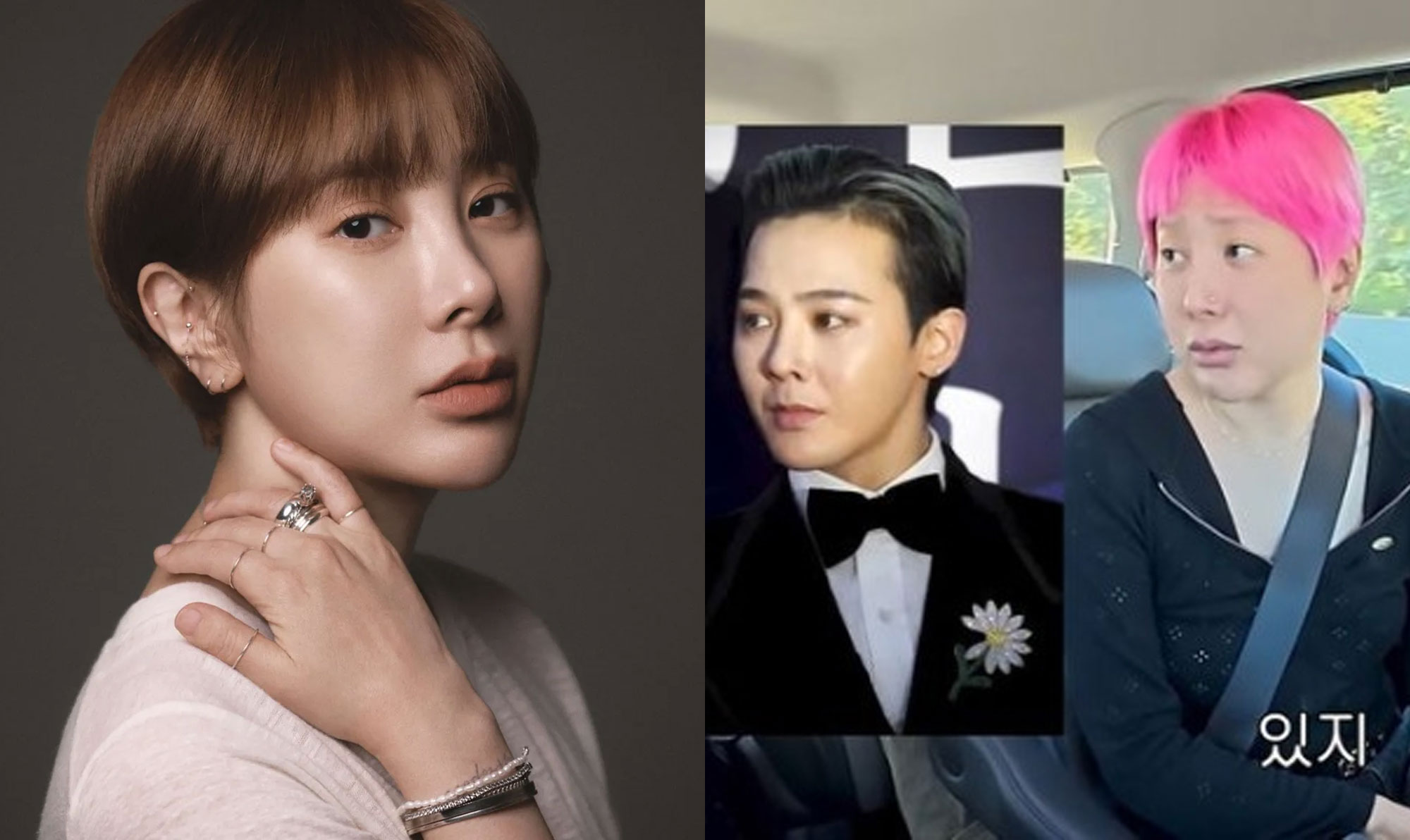

Broadcaster Lee Hye Sung indirectly referenced the controversy surrounding actress Ha Young’s great-grandfather and his pro-Japanese past, raising questions about a descendant’s responsibility for their ancestors’ misdeeds.
On October 20, Lee Hye Sung uploaded a video to her YouTube channel titled “Is the Society We Live in Right Now Just? | What Is Justice?” introducing Michael Sandel’s book Justice: What’s the Right Thing to Do?.

In the video, Lee Hye Sung addressed a recent public controversy over an official’s great-grandfather whose pro-Japanese actions during the Japanese colonial rule came to light. Although she did not explicitly name the individual, her remarks drew attention for clearly referencing the controversy surrounding Ha Young’s great-grandfather.
Lee Hye Sung stated, “Recently, a controversy arose when the pro-Japanese actions of a public figure’s great-grandfather during the Japanese colonial period were revealed. Regarding this, some expressed anger while others urged caution.”
She went on to discuss past historical issues, including assets owned by perpetrators and their descendants, as well as apologies and reparations between perpetrator nations and victim nations. She then questioned, “While there is no room for debate regarding the clear wrongdoing of historical perpetrators, must we tone for our ancestors’ sins on their behalf?”
She added, “Must a nation apologize for past historical wrongdoings? If so, where does the moral and philosophical basis come from? Are the wealth, honor, and social standing in our current society being distributed fairly to those who truly deserve them?”
Lee Hye Sung explained that these questions ultimately lead back to the core issues of “What is justice?” and “What makes a society just?” She shared that these recent thoughts prompted her to reopen the book and explore various perspectives on justice.
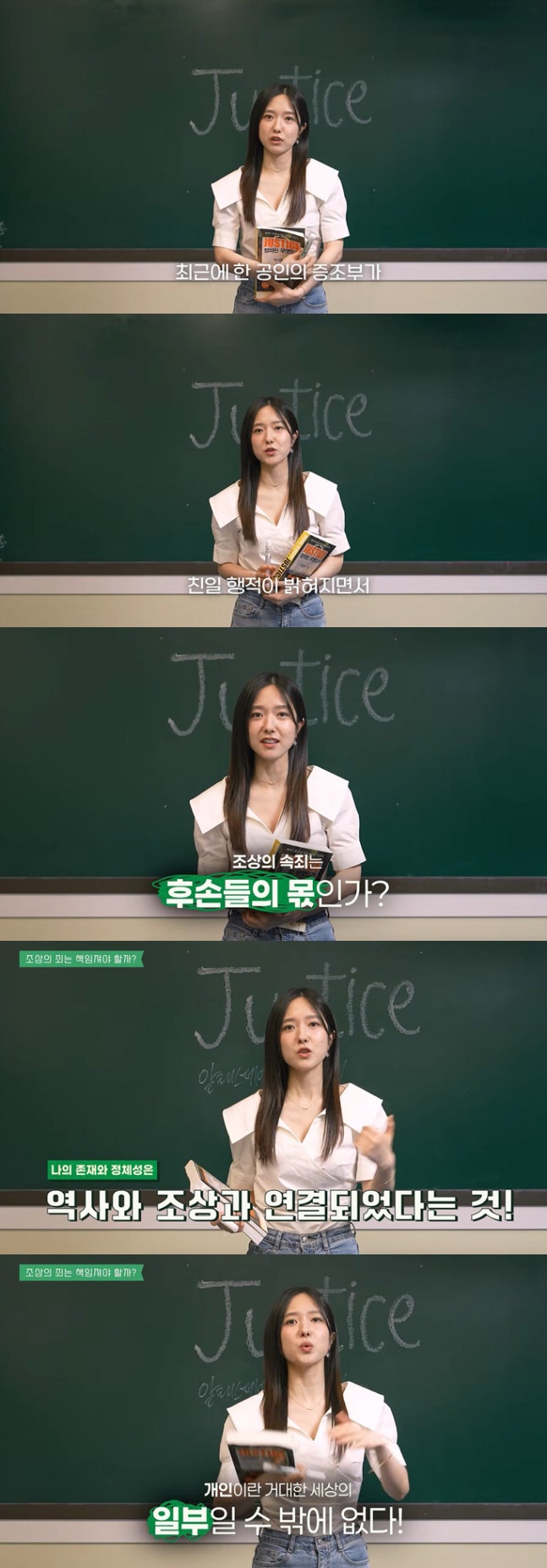
Particularly in the latter half of the video, she delved into detailed discussions about the misdeeds of ancestors and the responsibilities of descendants. Mentioning that wealth accumulated through pro-Japanese collaboration remains a subject of ongoing debate, she explained that if wealth was obtained through unjust means, measures should be taken to rectify the injustice.
Introducing libertarian philosopher Robert Nozick’s theory of entitlement, she explained, “Robert Nozick’s logic is that if money was earned through unjust means—such as plundering slaves, colonies, or indigenous peoples’ land and property—that injustice should be rectified through means like taxation or reparations.”
She also addressed how responsibility for historical wrongdoings should be shared. Introducing Germany’s Holocaust apologies and reparations as examples, she cited Japan’s historical apology issue and the debate over slavery reparations in the United States to question how nations and societies should accept past wrongdoings.
During this process, Lee Hye Sung raised the question, “Why should we be responsible for the wrongdoings of previous generations, for events that happened before I was even born?” She then introduced the views of philosopher Alasdair MacIntyre.
Explaining the perspective that views humans as “narrative beings,” she conveyed that individuals do not exist in isolation, detached from the past, but form their identity within the context of history, culture, and community.
She continued, “We cannot selectively inherit historical consciousness by taking only the proud and good parts of our history while casting aside the unpleasant parts. Like it or not, we are born carrying everything done by our ancestors.”
She further explained that “everyone, as a person with a specific social identity, must understand the environment surrounding themselves.”
Meanwhile, Ha Young recently mentioned on a variety show that her family consisted of four generations of doctors. However, she subsequently faced pro-Japanese controversy when her great-grandfather Ahn Sang-ho’s actions during the Japanese colonial period were revealed. Her agency initially denied the allegations before reversing its stance and apologizing. Ha Young also issued a personal apology, reflecting on her ignorance of history and careless remarks.