
South Korean actress Ha Young recently sparked a major online controversy. The backlash began after she spoke about her family background on a variety show. Netizens investigated her family history and discovered her great-grandfather had ties to a pro-Japanese group (Chinil). Her agency has now acknowledged the issue and issued a public apology to the public.
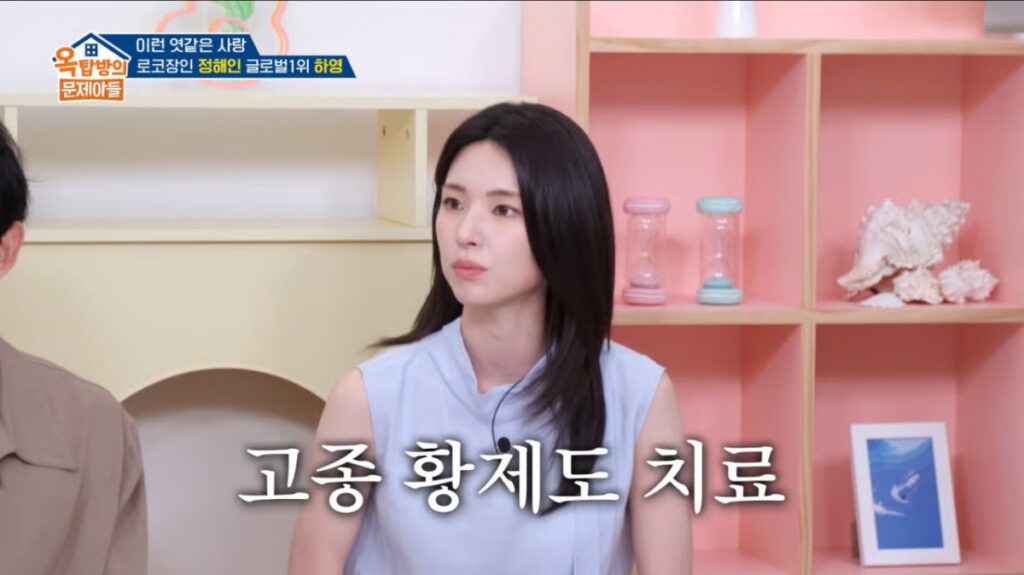
The controversy started when Ha Young appeared on the KBS2 variety show Problem Child in House (옥탑방의 문제아들). During the episode, she proudly talked about her family’s four generations of medical doctors. Her great-grandfather, grandfather, father, and older sister all practiced medicine. She shared, “My great-grandfather opened the first Western medical clinic in Hanyang (now Seoul). He even treated Emperor Gojong.”
Following the broadcast, netizens researched her great-grandfather and raised suspicions about his pro-Japanese ties (Chinilpa). At first, her agency, Bistus Entertainment, quickly denied the allegations. They stated, “Ha Young’s great-grandfather was indeed Ahn Sang-ho. However, the claims circulating online regarding pro-Japanese activities are completely groundless.”
However, deeper investigations later revealed more details about Ahn Sang-ho. He had served as a council member for the Daejeong Business Friendship Association (대정실업친목회). This organization was a pro-Japanese group made up of Joseon elites, with Lee Wan-yong serving as an advisor.
Furthermore, people discovered an article from the 1918 newspaper Maeil Shinbo (매일신보). The article bore the headline “The Family of Doctor Ahn Sang-ho, Who Became Completely Japanese.” It described him as a pioneer who brought Western medicine to Joseon and achieved great success. In the interview, Ahn Sang-ho stated, “I am just like a Japanese person. I do not own a single set of Joseon clothes (Hanbok) now.” This statement showed that his family’s lifestyle barely differed from the Japanese during that era.
On August 11, Bistus Entertainment released another statement to retract their previous denial and apologize for the incident. They stated, “We want to clarify our previous statement where we said the claims were groundless. After additional verification, we confirmed that Ahn Sang-ho’s name appears on the 1916 council member roster for the association.”
The agency expressed deep regret, saying, “We sincerely apologize for causing confusion by issuing a hasty denial without sufficient investigation.”
They also shared Ha Young’s current feelings: “Ha Young simply mentioned her family’s four-generation medical background while answering a question on the show. She feels very heavy-hearted for unintentionally causing this controversy.”
The agency added, “Through this incident, we deeply realize how carefully we must verify historical and personal facts before sharing them with the public. Ha Young will keep this concerning incident in mind and conduct herself with greater caution and humility in the future.”

Ha Young’s great-grandfather, Ahn Sang-ho, graduated from Tokyo Jikei University School of Medicine in Japan in 1902. He became the first Korean to earn a Japanese medical license. He returned to Korea in 1904 and opened a private clinic in Jongno 3-ga, Seoul. Later in 1919, records show he joined Japanese physicians to treat Emperor Gojong.
The most sensitive issue sparking anger among the South Korean public is not just his association membership. It is the record showing he treated Emperor Gojong alongside Japanese doctors in 1919—the exact year the Emperor died suddenly.
In Korean history, strong suspicions and rumors persist that Japanese authorities poisoned Emperor Gojong. His sudden death fueled public rage and triggered the March 1st Movement, Korea’s largest national independence demonstration. When Korean society sees a Korean doctor collaborating with Japanese medical staff at such a critical moment, people view it with deep suspicion. Rather than a supreme medical honor, many see it as receiving special privileges through collaboration with colonial rulers.
Consequently, viewers felt deep hurt when a descendant like Ha Young spoke proudly of this history on television. The story reopened painful historical wounds for the Korean public. During that same era, countless Korean ancestors sacrificed their lives, property, and freedom to resist colonial oppression.